
Kitchen cabinet organizers for Chicago-area kitchens
Refacing is the easiest time to fix the cabinets that don’t work. Here’s what can go inside them and how to decide what your kitchen actually needs.
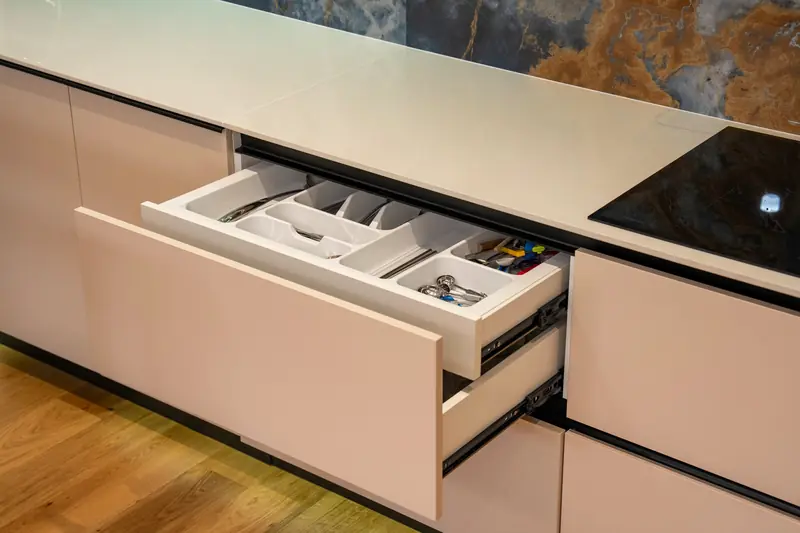
Better storage in the cabinets you already have
Most kitchens have enough cabinet space; the trouble is reaching it. Kitchen cabinet organizers fix that by bringing the back of the cabinet to you, and adding them while you reface your Chicago-area kitchen means they go in during the same installation, with no separate project later.
Organizers are fitted into your existing cabinet boxes. Each one has to clear the face frame opening, the hinges and any plumbing, so your designer checks inside dimensions at the consultation and your project manager confirms them at the precision measure.
Start with the cabinets you avoid: the corner you can’t reach, the base cabinet with pans stacked three deep, the cabinet under the sink. One well-placed pull-out often does more than a dozen small upgrades.
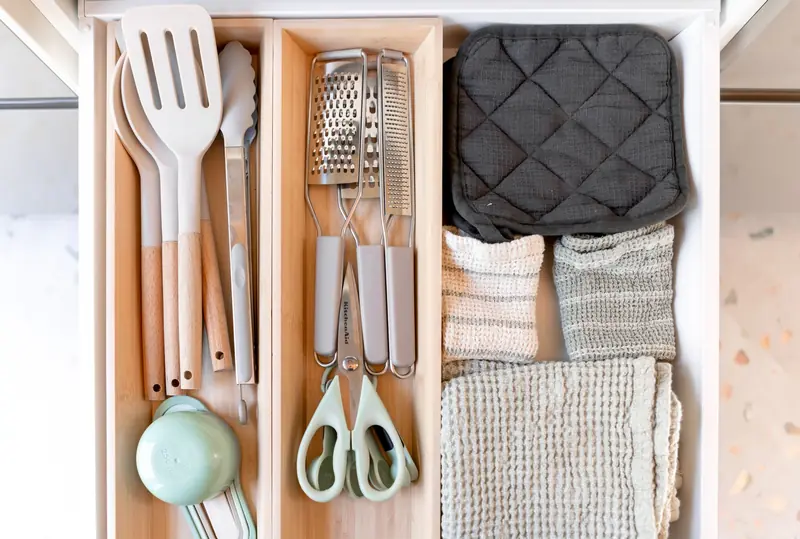
Pull-outs for base and pantry cabinets
Most of these replace fixed shelves with trays or bins on full-extension slides, so you can see and reach everything without kneeling.
Pull-out shelves and drawers
- Roll-out trays behind existing doors for pots and small appliances
- Full-extension slides, so the back of the tray clears the cabinet
- Soft-close slides, so loaded trays shut gently
- U-shaped trays that fit around sink plumbing
Trash and recycling
- Single or double bins on a pull-out frame
- Wider base cabinets can hold separate trash and recycling bins
- Best placed next to the sink or dishwasher
- Door-mounted versions slide out as you open the door
Tall and narrow
- Pantry pull-outs with adjustable shelves
- Narrow base pull-outs for oils, sprays and spices
- Pull-out towel bars beside the sink
- Pull-down shelves that bring high wall-cabinet shelves within reach
Inside the drawers
Inserts turn a drawer of loose items into one you can scan at a glance.
-
Spice inserts
Tiered inserts hold jars at an angle so every label faces up. A drawer right next to the range is the natural spot.
-
Utensil and cutlery dividers
Fixed or adjustable dividers keep flatware, cooking tools and knives sorted. An in-drawer knife block frees up counter space and protects the edges.
-
Tray dividers
Vertical dividers store baking sheets, cutting boards and platters on edge, so you can pull one out without lifting the rest. A narrow base cabinet near the oven works well.
-
Mixer lift
A spring-assisted shelf that swings up and locks at counter height, so a heavy stand mixer never has to be lifted. It needs a base cabinet with a full-height door, usually at least 15" wide.
Under-cabinet lighting and valances
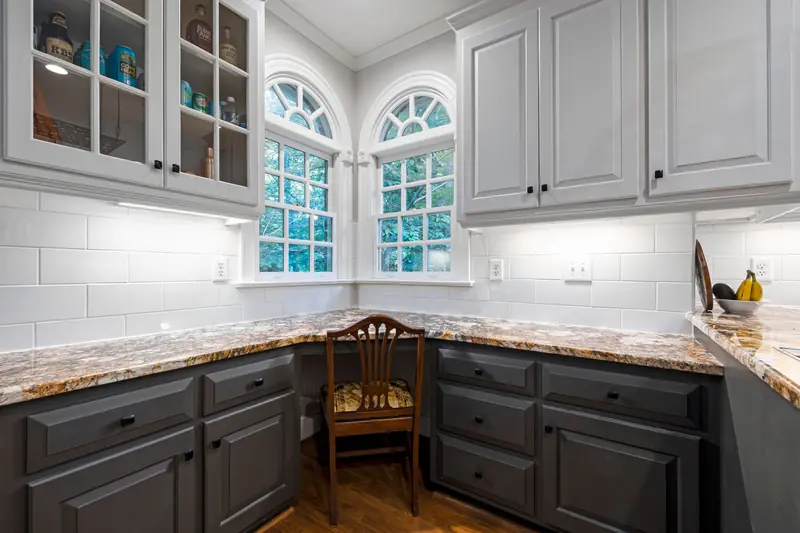
Under-cabinet lighting puts light on the counter where you work, instead of behind you where your own shadow falls on the cutting board. LED strips give an even line of light; puck lights create soft pools and are often used inside glass-front cabinets.
For a warm look, choose a color temperature around 2700K–3000K and keep it consistent with your ceiling lights. Mount fixtures near the front of the cabinet for even light across the counter, with a light rail to hide them from view.
A valance is a decorative panel that spans the space over the sink window, joining the wall cabinets on either side. It finishes the run visually and can hide a small light over the sink.
- LED strips or puck lights
- Warm 2700K–3000K color to match ceiling lights
- Dimmable options for evenings
- Light rail and valances matched to your doors
How to plan your storage
Ten minutes with a notepad before the consultation makes the conversation far more useful.
-
Empty one problem cabinet
Pick the cabinet you dread opening and take everything out. Note what lives there and what you never use.
-
Measure the awkward items
Sheet pans, the stand mixer, the tallest bottles, your trash can. These sizes decide which organizers will fit.
-
Map your work zones
Pots near the range, dishes near the dishwasher, trash next to the sink. Organizers do the most good where you reach most often.
-
Rank your fixes
List your top three frustrations. Solving those first gets more done than spreading the budget thin.
-
Review it with your designer
At the consultation, your designer checks each cabinet and suggests organizers that fit, each one itemized on your written quote. See our process for what happens next.
Cabinet organizer questions
Have a question we didn’t answer? Call (630) 555-0140 or send us a note.
Can organizers be added to my existing cabinets?
Yes. Most pull-outs, Lazy Susans and inserts are designed to retrofit into existing cabinet boxes. The main limits are the width of the face frame opening, hinge clearance and plumbing under the sink, which your designer checks before recommending anything.
What’s the best organizer for a blind corner cabinet?
For heavy items and the most usable space, a two-part blind-corner pull-out brings the whole corner forward. Swing-out half-moon shelves are simpler and work well for pots and lids. Which one fits depends on the opening width and cabinet depth.
Will a pull-out trash can fit in my kitchen?
Usually. A single bin fits many narrow base cabinets, and wider bases can hold separate trash and recycling bins. If there’s no good cabinet beside the sink, a door-mounted bin can sometimes go in the sink base itself.
Do pull-out shelves reduce storage space?
Slightly, because the slides take up a little width. In practice you gain usable space, since nothing at the back of a deep cabinet gets lost or forgotten.
Can under-cabinet lighting be added during refacing?
Yes. Under-cabinet lighting and light rail are both options during refacing, and the light rail is finished to match your new doors so the fixtures stay out of sight.
See your kitchen with new doors before you commit
A designer comes to your home with door samples, finishes and hardware, measures your cabinets and leaves a written, itemized quote. It’s free, and there’s no pressure to decide that day.
- Tell us a little about your kitchen
- Pick a time for your in-home design visit
- New doors installed in 3–5 days