
Kitchen sinks in Chicago: bowls, mounts and materials
A new countertop is the right time to change your sink. Here’s how to choose the bowl layout, mounting style, material and faucet that suit the way you cook.
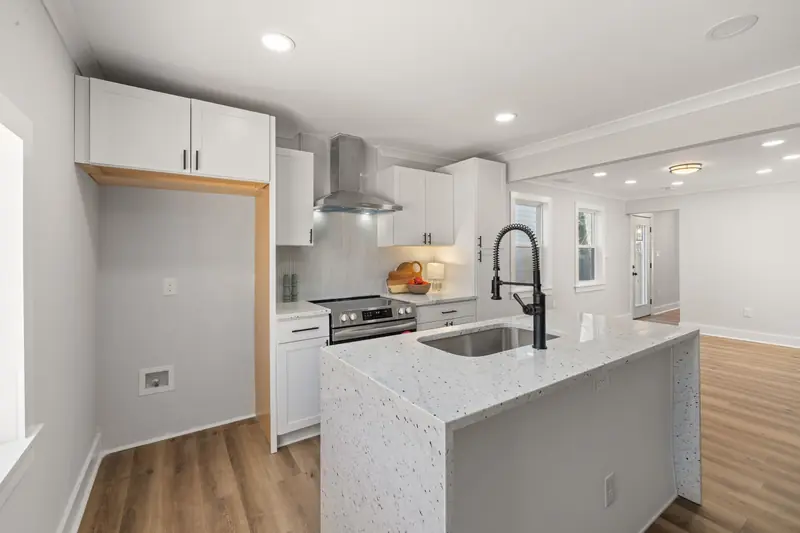
Choose the sink with the countertop
The sink is the hardest-working spot in the kitchen, and the easiest time to change it is when the countertop is being replaced. We install kitchen sinks in Chicago-area and Wisconsin homes as part of countertop projects, with the new sink and faucet going in alongside the new top.
Size starts with the cabinet underneath. A common rule of thumb is that the sink can be up to about 3" narrower than the sink base cabinet, so a 36" sink base usually takes a sink up to 33" wide. Bowl depth matters too: about 9"–10" hides dishes and limits splashing without making you stoop.
If your sink and countertop are staying, refacing doesn’t disturb them. The sink stays connected throughout the job.
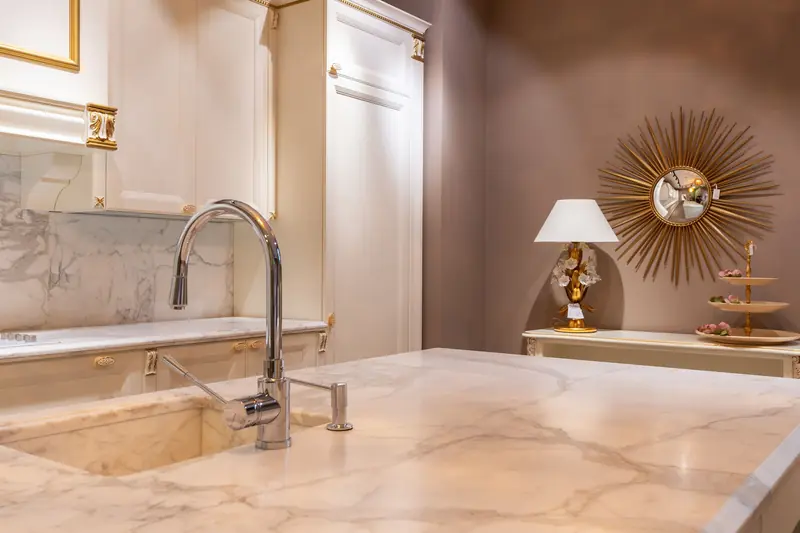
Undermount, drop-in or farmhouse
How the sink mounts affects cleanup, which countertops you can use and the cabinet underneath.
| Undermount | Drop-in | Farmhouse (apron front) | |
|---|---|---|---|
| How it mounts | Attached to the underside of the countertop | Rim rests on top of the countertop | Sits in the sink base with its front panel exposed |
| Countertops | Quartz, granite, solid surface | Any, including laminate | Usually stone or solid surface |
| Cleanup | Wipe crumbs straight into the bowl | The rim catches crumbs and grime | Wipe straight in; the front takes some splashes |
| Cabinet work | None beyond the countertop cutout | None | Sink base must be built or modified for the apron |
| Look | Clean, uninterrupted counter edge | Visible rim; practical and familiar | Deep basin that becomes a focal point |
| Relative cost | $$ | $ | $$–$$$ |
Farmhouse sinks are heavy and need solid support under the basin. If you want one, plan the sink base change with your refacing so its new front matches the other cabinets.
Sink materials
Three materials cover most kitchens, and each handles noise, scratches and hard water differently.
-
Stainless steel
Durable, heat-proof and a little more forgiving with dropped glasses than harder materials. A brushed finish hides fine scratches, which blend together over time.
-
Gauge, explained
Steel thickness is measured in gauge, and a lower number means thicker steel. Look for 16 or 18 gauge; thinner sinks dent and drum more easily.
-
Quieter stainless
Pads or a spray-on undercoating on the underside deaden the drumming of running water and clattering pans. Check for them on any stainless sink.
-
Composite granite
Crushed quartz or granite bound in resin, in black, gray or white. It’s quiet and resists scratches and stains, though dark colors can show a white film where water is hard.
-
Fireclay
Clay fired at very high heat under a glossy glaze. It’s hard, easy to clean and holds its color, which makes it the classic farmhouse material. A dropped cast-iron pan can chip it.
-
Drains and corners
A rear-offset drain frees storage under the sink and stays clear when dishes pile up. Tight corners look crisp; rounded corners are easier to clean.
Choosing a faucet
The faucet gets as much use as the sink. Choose both at the same time so the holes in the countertop match.
Faucet styles
- Pull-down: a high-arc spout with a spray head that pulls straight down into the sink
- Pull-out: a lower spout with a spray head that pulls toward you, good under low windows
- Touchless: a motion sensor turns the water on and off, handy with messy hands; most run on batteries or a plug-in adapter
- Touch-activated: tap the spout or handle to start and stop the flow
Before you choose
- Count holes: one or three, plus any soap dispenser or filtered-water tap
- Check spout reach so the stream lands near the center of the bowl
- Measure clearance under a window or wall cabinet for high-arc models
- Match or deliberately contrast your cabinet hardware finish
How a new sink goes in with new countertops
When the countertop is replaced, the sink and faucet are installed as part of the same job.
-
Choose the sink and faucet early
Make the selection before templating. The countertop is cut for your exact sink model, and the faucet holes are drilled to match.
-
Templating after refacing
Once the cabinets are refaced, the countertop is templated on the finished cabinets. Fireclay sinks vary slightly in size, so they’re measured from the actual sink.
-
Fabrication
Stone tops take about 7–10 days to fabricate after templating. The sink cutout and faucet holes are made in the shop.
-
Install day
The old top and sink come out, the new top is set, the sink is mounted and the faucet and drain are connected. Countertop installation takes about one day.
-
Let the sealant cure
Undermount sinks are bonded with silicone that needs about a day to cure. Hold off on heavy pots or a full basin until your installer gives the go-ahead.
Kitchen sink questions
Have a question we didn’t answer? Call (630) 555-0140 or send us a note.
What size kitchen sink do I need?
Measure the sink base cabinet first; the sink is usually up to about 3" narrower than the cabinet. A 36" sink base takes a sink up to roughly 33" wide, which is roomy enough for a large single bowl or a 60/40 double.
Is a single or double bowl sink better?
If you run the dishwasher daily and cook with big pans, a single bowl is more practical. If you hand-wash a lot, a double or 60/40 gives you separate wash and rinse sides. A 60/40 with a low divider is a good compromise.
Can I put an undermount sink in a laminate countertop?
It’s generally not recommended. Standard laminate has an exposed core at the cutout that can swell if water gets in, so laminate tops almost always use a drop-in sink. For an undermount, choose quartz, granite or solid surface.
What gauge stainless steel sink is best?
16 or 18 gauge. Lower numbers are thicker, so a 16-gauge sink is sturdier and quieter than an 18, and both are a clear step up from thinner 20- or 22-gauge sinks.
Can I change my sink without replacing the countertop?
With a drop-in sink, often yes, as long as the new sink covers the existing cutout. Replacing an undermount sink or switching mounting styles usually means a new countertop, which is why most people choose the sink when they choose the top.

See your kitchen with new doors before you commit
A designer comes to your home with door samples, finishes and hardware, measures your cabinets and leaves a written, itemized quote. It’s free, and there’s no pressure to decide that day.
- Tell us a little about your kitchen
- Pick a time for your in-home design visit
- New doors installed in 3–5 days