Doors and drawer fronts cover most of what you see in a kitchen, so the door style sets the tone more than almost any other choice. When you reface your cabinets, you aren’t stuck with the style you have: every door and drawer front is replaced, so you can go from 1990s raised panel oak to a painted Shaker, or from Shaker to a flat slab. This guide compares the three cabinet door styles we make, Shaker, flat and raised panel, and how to match them to Chicagoland and Wisconsin homes, from brick bungalows to new builds.
The three door styles at a glance
Shaker (recessed panel)
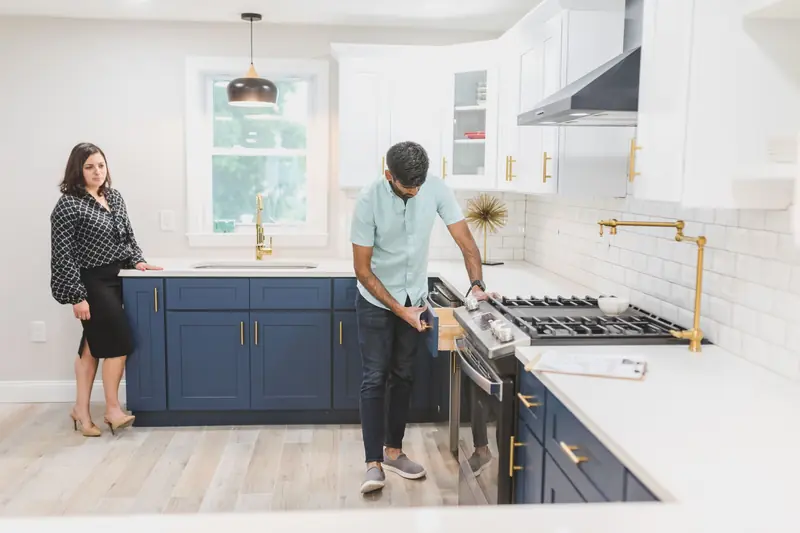
A Shaker door is a flat center panel set inside a square frame of four pieces: two vertical stiles and two horizontal rails. The look is simple and squared-off, with one clean shadow line around the panel. It works in traditional, transitional, farmhouse and plenty of modern kitchens, which is why it shows up in so many of them.
Flat panel (slab)
A slab door is one flat surface with no frame and no profile. It reads as modern and minimal, puts all the attention on color or wood grain, and makes a small kitchen feel calmer because there are fewer lines. It’s also the least forgiving visually: the gaps between doors are easy to see, so precise installation matters.
Raised panel
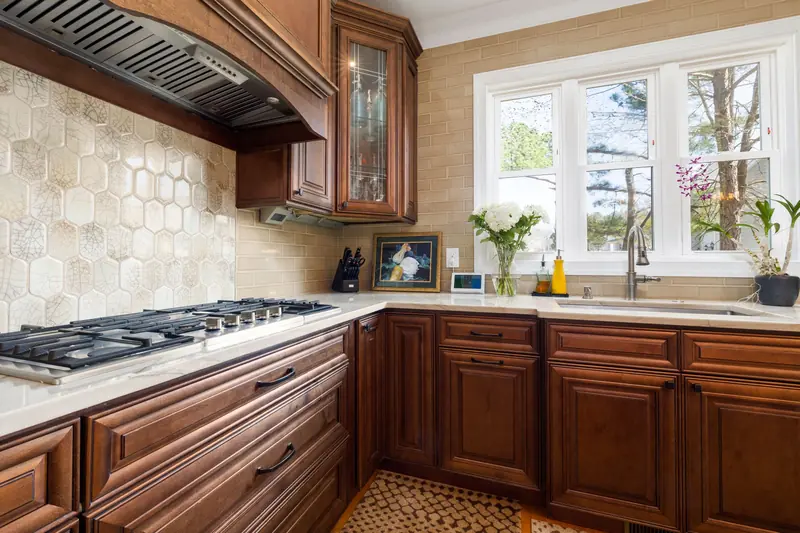
A raised panel door has a center panel shaped so its middle sits proud of the edges, with a routed profile around it. Panels can be square or cathedral (arched at the top). Raised panel is the most formal and traditional of the three, and it suits homes with detailed trim, crown molding and classic furniture.
Match the door to your home’s era
Your kitchen doesn’t have to copy the age of your house, but doors that agree with the trim, windows and floors around them look settled rather than dropped in. A few common patterns:
1910s–1930s bungalow
Chicago brick bungalows and Craftsman homes have strong, simple woodwork: wide trim, square edges, built-ins. Shaker fits naturally. A stained wood veneer in oak or cherry echoes the original millwork, while a painted Shaker in a muted green, cream or deep blue keeps the period feel with a lighter kitchen. Skip cathedral raised panels here; they belong to a different kind of house.
1950s–1960s ranch
Mid-century ranches have long, low lines, big windows and little ornament. Flat slab doors in walnut veneer or a warm wood stain suit them well, especially with long horizontal pulls. If slab feels too stark, a simple Shaker in a light paint color reads clean without going fully modern.
1990s colonial or two-story
Many 1990s homes in the suburbs came with honey oak raised panel cabinets, often with cathedral uppers. It’s one of the most common kitchens people want to update, and there are two good directions. Keep a square raised panel for a formal, traditional house and change the color to white, cream or a deeper cherry stain. Or switch to Shaker for a transitional look that still respects the home’s trim and moldings. Losing the arched uppers alone makes a big difference.
New build or recent construction
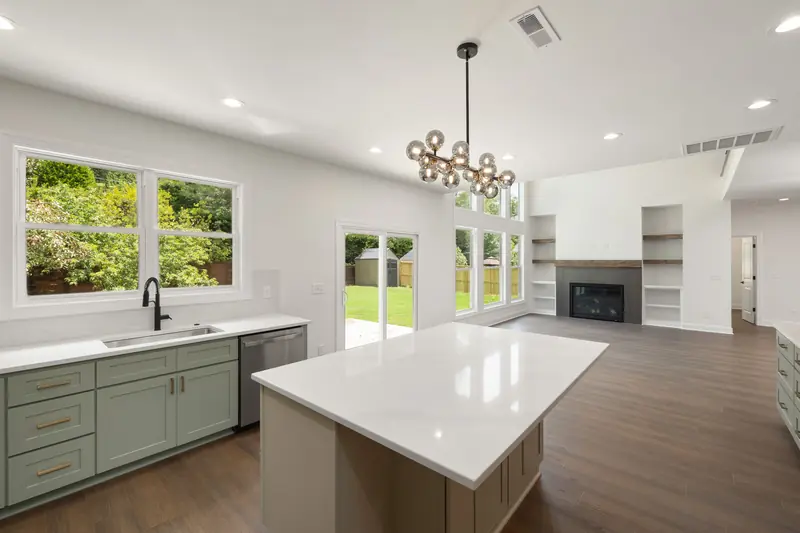
Builder-grade kitchens in newer homes often have a basic Shaker or flat door in a standard finish. Refacing here is usually about upgrading quality and color rather than changing the style: a richer finish, two-tone cabinetry with a darker island, soft-close hinges and organizers. In a modern new build with open sightlines, flat panel cabinets in a matte color or wood veneer give the kitchen a furniture-like look from the living room.
Colors and finishes
Door style and finish work together. A color that looks quiet on a slab door looks busier on a raised panel, because the profile catches light and shadow. Our doors come in three material families:
- Rigid thermofoil (RTF): a smooth, uniform surface that wipes clean easily. A practical choice for Shaker and slab doors in solid colors.
- Real wood veneer: maple, cherry, oak and walnut, stained to show the grain. Best when you want warmth and a natural look.
- Painted finishes: deep, even color with the character of a painted door.
Color pairings that tend to age well:
- White and off-white work with every style. Warm whites look softer on raised panel; crisp whites suit slab and Shaker.
- Greige and soft gray are easy on a Shaker door and hide fingerprints better than bright white.
- Sage, green and navy look best on Shaker, where the frame gives the color some structure. They also work on an island alone if you want color in smaller doses.
- Wood tones suit slab doors in a mid-century or modern kitchen, and raised panel in cherry or stained maple for a traditional one.
Two-tone kitchens are an easy way to try a bolder color: lighter uppers and perimeter, a darker or wood-toned island. Browse cabinet doors and finishes for the full range, or see finished kitchens in our gallery.
Pairing hardware with your door style
Hardware is small, but you touch it every day and it finishes the look of the door.
- Shaker: the most flexible. Bar pulls in matte black or brushed brass for a current look, or knobs on doors with cup pulls on drawers for a farmhouse or period kitchen.
- Flat panel: long bar pulls, slim edge pulls along the top of doors and drawers, or oversized pulls on wide drawers. Keep finishes simple: stainless, matte black, brushed nickel.
- Raised panel: knobs and bin pulls in traditional finishes such as oil-rubbed bronze, antique brass or polished nickel. Very thin modern pulls can look out of place on a detailed door.
A few sizing and placement rules of thumb:
- On drawers, a pull around one-third of the drawer width looks balanced. Wide drawers, 30 inches and up, can take two pulls or one long one.
- On doors, mount pulls vertically on the stile opposite the hinge, a couple of inches in from the corner: near the bottom on wall cabinets, near the top on base cabinets.
- Pick one main finish and repeat it. A second finish works if it shows up at least twice in the room, for example on the faucet and the light fixtures.
See cabinet hardware for pulls, knobs and finishes.
Maintenance: what each style asks of you
The shape of a door decides where dust and grease collect.
- Raised panel needs the most attention. The routed profile around the panel catches dust, and near the range those grooves collect a film of cooking grease that turns sticky. Running a soft brush or microfiber cloth along the profile every couple of weeks keeps it from building up.
- Shaker has one inside edge where the panel meets the frame. Crumbs and dust settle on the bottom rail, mostly on base cabinet doors. A quick wipe along that ledge is usually all it needs.
- Flat panel is the easiest to clean because there’s nowhere for dust to hide. The trade-off is that smudges and fingerprints show more, especially on dark or high-gloss finishes. Hardware on every door and drawer keeps hands off the surface.
For every style and finish, wipe with a soft cloth and warm water with a little mild dish soap, then dry. Avoid abrasive pads, scouring powder, ammonia and harsh solvents, and don’t let water sit on door edges around the sink and dishwasher. Keep steam from a kettle or coffee maker from blowing straight onto doors, and give doors near the oven some air during a self-cleaning cycle.
Quick comparison
| Shaker | Flat panel | Raised panel | |
|---|---|---|---|
| Look | Clean, squared-off frame | Minimal, modern | Formal, traditional |
| Fits best in | Bungalows, colonials, farmhouse and transitional kitchens | Ranches, modern new builds, small kitchens | Traditional colonials and two-story homes |
| Cleaning | Easy, wipe the bottom rail | Easiest, shows fingerprints | Most effort, dust in the profile |
| Hardware | Almost anything | Long bar or edge pulls | Knobs, bin pulls, traditional finishes |
See the doors in person
Photos only go so far. Door profiles look different in daylight, and colors shift between a screen and your kitchen. During a free in-home consultation, a designer brings door samples, finish swatches and hardware so you can hold them up against your countertops, floors and walls. You can also see full doors at our showrooms in Wood Dale, St. Charles, Madison and New Berlin. Still deciding whether to reface at all? Read cabinet refacing vs. replacing first.
Cabinet door style questions
Have a question we didn’t answer? Call (630) 555-0140 or send us a note.
Is Shaker still a safe choice for a kitchen?
Yes. The Shaker door has been around in one form or another for well over a century, and its simple frame adapts to whatever finish and hardware you pair with it. If you want a kitchen that won’t feel dated quickly, it’s the lowest-risk choice.
Can I change my door style when refacing?
Yes. Refacing replaces every door and drawer front, so you can choose any of the three styles regardless of what you have now. The face frames and end panels are covered with matching veneer so the whole kitchen reads as one.
Which cabinet door style is easiest to keep clean?
Flat panel, followed closely by Shaker. Raised panel profiles collect dust and grease, so they need a soft brush or cloth run along the grooves every so often.
Can I mix door styles in one kitchen?
You can, in moderation. A common approach is Shaker on the perimeter with a flat panel or a contrasting color on the island. Stick to two styles at most so the kitchen still looks planned. See cabinet doors and hardware for options.